Strength Training for Men Over 50: A Practical Guide
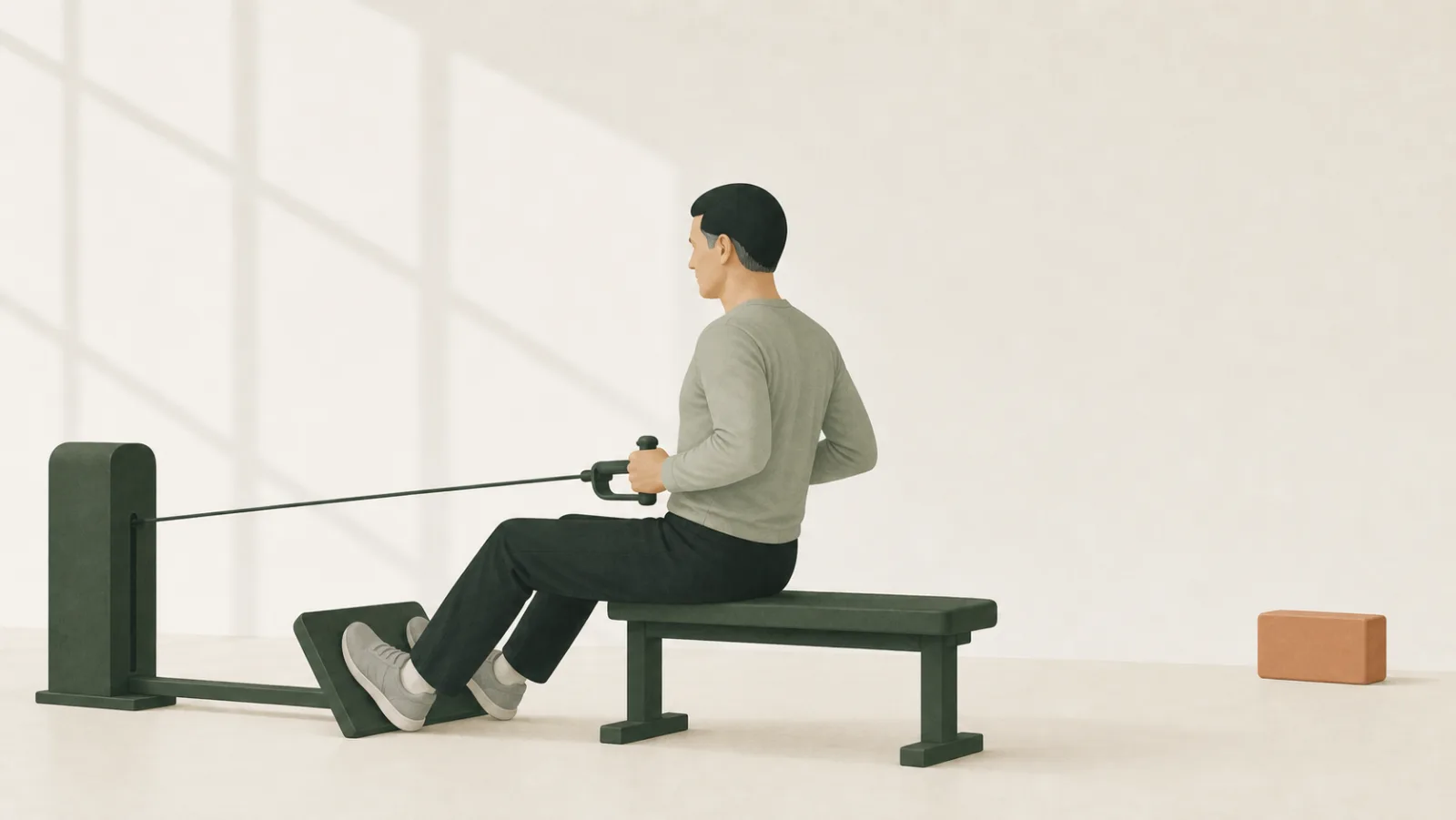
Advice for men over 50 tends to arrive in one of two flavours. Either nothing changes and you should train as you always did, or everything changes and you need a special programme built around joint preservation.
The research supports neither position cleanly, partly because most of it studied men considerably older than 50.
Key Takeaways
- A 2025 meta-analysis of 12 trials in sarcopenic older adults found resistance training improved grip strength and physical function, with a moderate effect size in both.
- In the same analysis, the effect on skeletal muscle mass index was not statistically significant.
- Training frequency and intensity predicted the grip strength result in meta-regression. A subgroup comparison across trials also favoured programmes containing pulling exercises, though no trial randomised that comparison.
- That analysis studied people already diagnosed with sarcopenia, which is not the same population as a healthy fifty-year-old.
What the dose-response evidence found
A 2025 systematic review and meta-analysis in BMC Geriatrics pooled 12 randomized controlled trials covering 538 sarcopenic older adults, and looked specifically at which training variables predicted results.
Compared with controls, resistance training produced a moderate improvement in grip strength, with a standardized mean difference of 0.63 and low heterogeneity between studies. Physical function, measured by the short physical performance battery, improved with a standardized mean difference of 0.56.
The result on muscle mass is the one worth sitting up for. The effect on skeletal muscle mass index was 0.24 with a confidence interval running from -0.05 to 0.53, which did not reach statistical significance. In this pooled analysis, in this population, training reliably improved what people could do without a clear corresponding change in how much muscle the measurement said they had.
Two variables predicted the strength result in meta-regression: training frequency and training intensity. The authors' practical conclusion was that moderate-intensity resistance training twice a week is a promising strategy.
A subgroup analysis also found larger grip strength improvements in trials whose programmes included pulling exercises. That comparison is between studies rather than within them. No trial randomised participants to pulling or no pulling, so the difference could reflect anything else those programmes had in common. It is a hypothesis worth noticing, not a finding.
The review itself was small, at 12 trials and 538 participants, and the authors graded the certainty of the evidence rather than presenting it as settled. Read the whole thing as a reasonable current best guess.
The population problem
Everything above came from adults who already met criteria for sarcopenia, which is age-related loss of muscle mass and function severe enough to be diagnosed.
That is not a description of most fifty-year-old men. Results from a population with established muscle loss say something about reversing a deficit; they do not necessarily describe what happens in someone who has not developed one. The direction is likely to hold. The magnitudes and the specific dose recommendations are borrowed.
This is worth stating because the "over 50" content genre almost universally cites research in people 15 to 25 years older without mentioning it. The honest summary is that resistance training in older adults is well supported, and the evidence specific to healthy men in their early fifties is much thinner than the volume of advice suggests.
Protein, since it always comes up
The PROT-AGE position paper, published by an international study group in the Journal of the American Medical Directors Association, addressed protein requirements in older people.
Its recommendation for people over 65 is an average daily intake of at least 1.0 to 1.2 g of protein per kilogram of body weight, rising to 1.2 g/kg or more for those who are exercising and otherwise active, and 1.2 to 1.5 g/kg for most older adults with acute or chronic illness. The reasoning is that ageing changes protein metabolism, including a declining anabolic response to a given dose of ingested protein.
Note the age band again. This is a position paper about people over 65, not a study of fifty-year-olds, and a position paper is expert consensus rather than an experiment. It is a reasonable reference point rather than a number that has been tested on your demographic.
What this supports
Two sessions a week at an intensity that is actually demanding is the dose the dose-response analysis pointed at, and frequency and intensity were the variables that mattered rather than the exercise list.
Include pulling movements if you were choosing anyway. The subgroup signal is weak evidence and pulling work is worth doing on other grounds, so this is a cheap bet rather than a recommendation the data earns.
Expect strength and function to respond more visibly than the scale or a body composition scan. That is what the pooled data showed, and it is a useful expectation to set, because judging a programme by muscle mass measurements is the fastest route to concluding it is not working when it is.
Beyond that, the ordinary principles apply. Nothing in this literature suggests men over 50 need a separate category of exercise, and the trials used conventional resistance training.
References
- Ran J, Yang J, Li N, et al. Dose-response effects of resistance training in sarcopenic older adults: systematic review and meta-analysis. BMC Geriatrics. 2025;25(1):849. doi:10.1186/s12877-025-06559-4. Free full text.
- Bauer J, Biolo G, Cederholm T, et al. Evidence-based recommendations for optimal dietary protein intake in older people: a position paper from the PROT-AGE Study Group. Journal of the American Medical Directors Association. 2013;14(8):542–559. doi:10.1016/j.jamda.2013.05.021.
Related Articles
Ready to just show up?
Download Dorsi on the App Store — it handles your training decisions.
Download on the App Store