Should Seniors Lift Heavy Weights After 60?
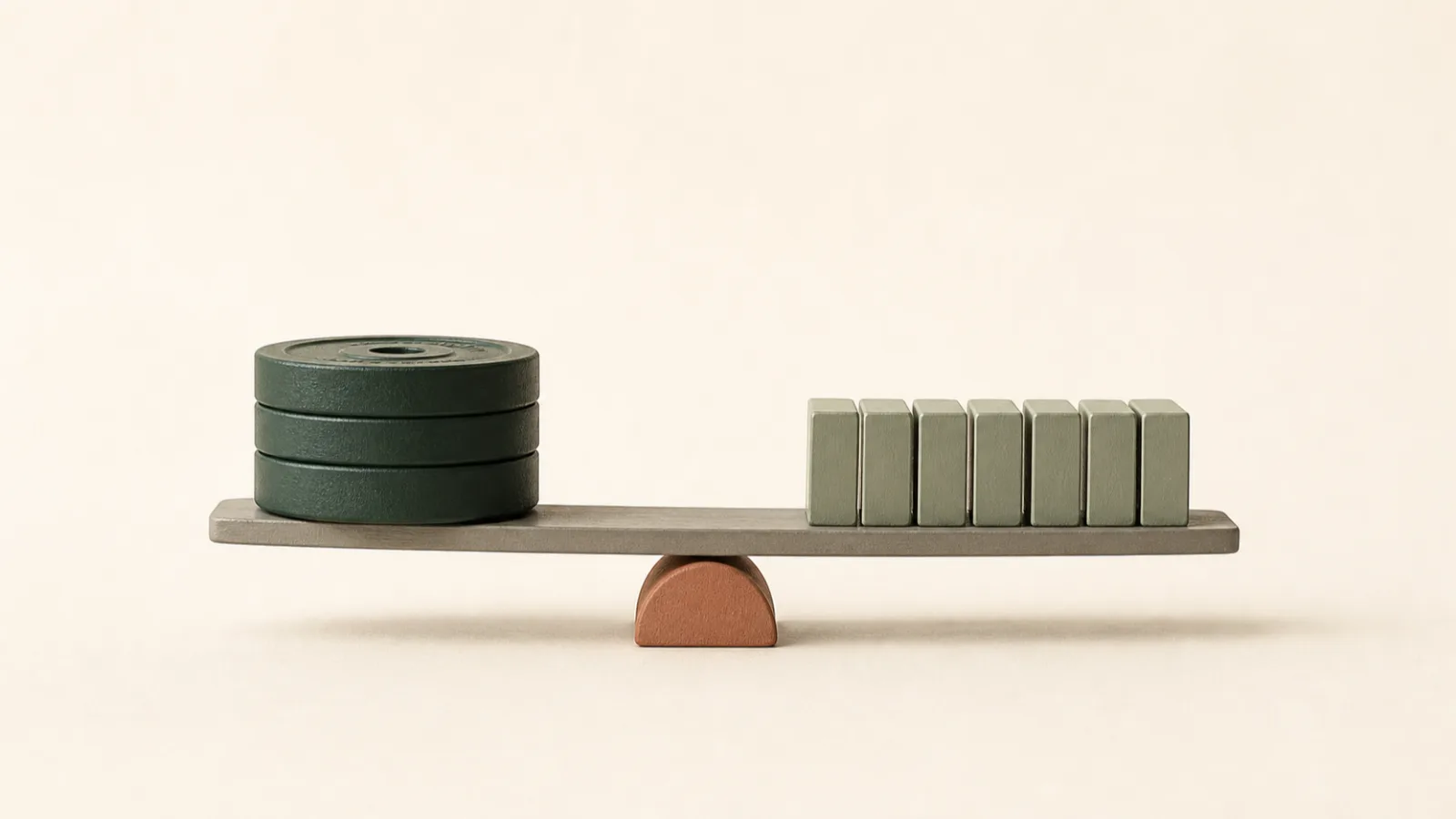
Discussions about resistance training after 60 often focus on the choice between heavy, low-repetition work and lighter work performed for more repetitions.
The research separates three variables inside that choice: the weight on each repetition, the effort of the set, and the amount of work done across the week. “Intensity” can refer to the first or the second. “Volume” is the third. Changing one does not hold the others still.
Key Takeaways
- Higher-load progressive training generally produces larger gains in maximum strength than low-load training in older adults.
- A 2025 network meta-analysis of 151 trials found low-volume training substantially improved lean mass, muscle size and physical function.
- In that same analysis, moderate and high volumes ranked better for lower-limb strength, so “volume does not matter” is not supported.
- Heavy and high-quality are not synonyms. The useful dose depends on whether the target is strength, muscle size, power or daily function.
What heavier loading buys
A 2010 meta-analysis of 29 trials compared resistance-training doses in 1,313 adults aged 65 to 81. High-intensity progressive resistance training produced larger improvements in maximum strength than moderate or low intensity. The standardized difference was 0.88 against low intensity and 0.62 against moderate intensity.
Physical function improved too, but those gains did not clearly depend on training intensity. Power training, where the intent is to move quickly, performed especially well for muscle power and functional outcomes. A heavier load therefore bought more of one specific outcome, maximum strength, without winning every outcome measured.
A 2013 systematic review of 21 trials reached a similar headline: high-intensity lower-body training improved strength more than lower intensities. It also found that studies matching the amount of work between groups produced similar leg-strength improvements regardless of intensity. Most participants were healthy, sample sizes were small and adverse events were poorly reported, so the safety conclusion applies most comfortably to screened and supervised populations.
What 151 trials found about volume
The broadest recent analysis looked at volume rather than load. A 2025 network meta-analysis in Sports Medicine included 151 randomized trials and 6,306 people aged 60 or older.
The authors classified weekly volume from the product of training frequency, number of exercises and number of sets. Low-volume programmes ranked best for timed up-and-go performance, six-minute walking, lean body mass and lower-body muscle hypertrophy. The standardized effect for hypertrophy was 0.40, with a confidence interval from 0.25 to 0.54. Moderate and high volumes ranked best for lower-limb strength.
This finding makes low-volume training a credible effective dose rather than the universal optimum. Network meta-analysis combines direct and indirect comparisons, and “volume” here is a programme-level product rather than a clean count of hard sets for one muscle. The evidence for physically impaired adults was also limited. A low weekly dose can produce substantial gains, while more work may be useful when the target is maximum strength.
A different synthesis shows why the slogan remains unsettled. A 2024 secondary meta-analysis in postmenopausal and older women estimated about 1.3 kg of whole-body hypertrophy in higher-volume programmes and 0.9 kg in lower-volume programmes, each compared with inactive controls. The authors graded the evidence as low certainty, and the volume groups were not randomized head-to-head. It provides low-certainty evidence for a dose effect, with too much uncertainty to assign an exact return to each added set.
One trial that mixed heavy and light work
A 30-week randomized trial in 64 adults with age-related muscle atrophy tested four prescriptions. The groups differed in how often they performed high-resistance conventional lifting and whether they added a lower-resistance, high-velocity session.
The programme with two weekly high-resistance sessions plus one low-load, high-velocity session produced the largest gains in thigh muscle mass and total lean mass. Three conventional high-resistance sessions did not win. That group also showed increased expression of inflammatory cytokine receptors, which was associated with smaller gains.
This was one modest trial, and the mixed programme added a third session with a different contraction goal. Older adults in this sample did best with two exposures to substantial resistance and a separate power-oriented exposure, showing how different loading styles can share one programme.
Load, effort and volume are different decisions
A light set that stops while every repetition is still easy supplies little reason to adapt. A light set performed with high effort is a different stimulus. A heavy set can also be low quality if technique changes, range shortens or fatigue makes the intended muscle irrelevant.
The general progression is detailed in Weight Training After 60. For this comparison, its useful feature is that load and volume rise together: neither has to be maximal at the start.
The practical split is clearer when tied to the goal:
- Maximum strength: progressively heavier loads have the strongest comparative evidence.
- Muscle and general function: low-volume training already produces meaningful gains; more is optional rather than the entry fee.
- Power and fall-related function: moderate loads moved quickly can add something slow heavy repetitions do not train.
- Pain, frailty or joint limitation: the appropriate load may be lower and supervision more valuable. The set still needs a progression plan.
How quickly someone can repeat that work is addressed in the companion review of muscle recovery after 60.
Safety boundary. The studies supporting high-intensity training generally screened participants and often supervised sessions. A population-level finding does not clear a specific person with unstable cardiovascular disease, uncontrolled blood pressure, acute pain or a high fracture risk to test a heavy maximum.
Bottom Line
A productive programme uses a load that can progress and a weekly dose that can be repeated.
Heavier training has the clearest advantage for maximum strength. Low-volume programmes still improve muscle size, lean mass and function, and more sets can help some outcomes. Load should follow the goal, while volume should be high enough to work and low enough to recover from.
References
- Steib S, Schoene D, Pfeifer K. Dose-response relationship of resistance training in older adults: a meta-analysis. Medicine & Science in Sports & Exercise. 2010;42(5):902–914. doi:10.1249/MSS.0b013e3181c34465.
- Raymond MJ, Bramley-Tzerefos RE, Jeffs KJ, Winter A, Holland AE. Systematic review of high-intensity progressive resistance strength training of the lower limb compared with other intensities of strength training in older adults. Archives of Physical Medicine and Rehabilitation. 2013;94(8):1458–1472. doi:10.1016/j.apmr.2013.02.022.
- Radaelli R, Rech A, Molinari T, et al. Effects of Resistance Training Volume on Physical Function, Lean Body Mass and Lower-Body Muscle Hypertrophy and Strength in Older Adults. Sports Medicine. 2025;55(1):167–192. doi:10.1007/s40279-024-02123-z.
- Nunes PRP, Kassiano W, Castro-E-Souza P, et al. Higher volume resistance training enhances whole-body muscle hypertrophy in postmenopausal and older females. Archives of Gerontology and Geriatrics. 2024;124:105474. doi:10.1016/j.archger.2024.105474.
- Stec MJ, Thalacker-Mercer A, Mayhew DL, et al. Randomized, four-arm, dose-response clinical trial to optimize resistance exercise training for older adults with age-related muscle atrophy. Experimental Gerontology. 2017;99:98–109. doi:10.1016/j.exger.2017.09.018. Free full text.
Related Articles
Ready to just show up?
Download Dorsi on the App Store — it handles your training decisions.
Download on the App Store